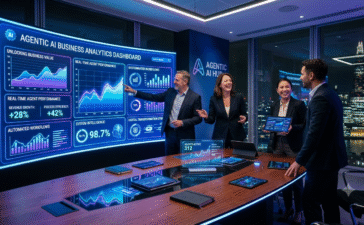
Businesses today are under constant pressure to improve productivity, reduce operational costs, and respond quickly to changing market demands. Traditional automation systems have helped organizations streamline repetitive workflows for years, but modern digital environments require more intelligent and adaptive solutions.
This is where AI agents are creating a major transformation.
AI agents are intelligent software systems capable of analyzing information, making contextual decisions, automating workflows, and learning continuously from real-time interactions. Unlike traditional rule-based automation tools, AI agents can adapt to dynamic environments and manage more complex business operations autonomously.
Organizations across industries are increasingly adopting AI agents to improve operational efficiency, strengthen customer engagement, optimize IT operations, and support smarter decision-making.
As digital transformation accelerates, AI agents are becoming one of the most valuable technologies helping businesses stay competitive and future-ready.
What Makes AI Agents Different?
Traditional automation systems typically rely on predefined workflows and fixed operational rules.
AI agents go beyond simple automation by using technologies such as:
- Machine learning
- Natural language processing
- Predictive analytics
- Real-time data analysis
- Contextual reasoning
These capabilities allow AI agents to:
- Learn from interactions
- Adapt to operational changes
- Execute multi-step workflows
- Generate recommendations
- Respond intelligently to business conditions
This makes AI agents significantly more flexible and scalable than traditional automation tools.
How AI Agents Improve Business Operations
Intelligent Workflow Automation
Organizations often spend significant time managing repetitive operational tasks manually.
AI agents help automate activities such as:
- Scheduling workflows
- Managing emails and communication
- Updating operational reports
- Organizing data and documentation
- Monitoring business processes
Automation reduces administrative workloads while improving operational consistency.
Employees can focus more on strategic initiatives and innovation instead of repetitive tasks.
Enhanced Customer Experiences
Customer expectations continue evolving rapidly across digital channels.
Businesses are using AI agents to improve customer engagement through:
- Intelligent virtual assistants
- AI-powered chat support
- Personalized customer communication
- Automated issue resolution
- 24/7 customer support availability
These capabilities improve customer satisfaction while helping organizations scale support operations more efficiently.
AI agents also help businesses deliver faster and more consistent service experiences.
Smarter Business Intelligence
Organizations generate enormous amounts of operational and customer data daily.
AI agents help businesses:
- Analyze business trends
- Monitor operational performance
- Generate predictive insights
- Detect anomalies and risks
- Improve strategic planning
This improves operational visibility and accelerates decision-making.
Business leaders can respond more effectively to changing market conditions and operational challenges.
Stronger IT and Cybersecurity Operations
AI agents are becoming increasingly important in enterprise IT management and cybersecurity.
Organizations use AI-powered agents to:
- Monitor infrastructure performance
- Detect cybersecurity threats
- Automate incident response
- Improve system reliability
- Identify operational bottlenecks
These capabilities strengthen operational resilience while reducing downtime risks.
AI-powered monitoring systems also improve visibility across complex enterprise environments.
Why AI Agents Create Competitive Advantage
Businesses that adopt AI agents strategically often improve:
- Productivity and efficiency
- Operational agility
- Customer engagement
- Decision-making speed
- Innovation capabilities
One major advantage of AI agents is their ability to operate continuously while processing large volumes of information rapidly.
Organizations can scale operations more effectively without significantly increasing operational workloads.
In competitive digital markets, faster execution and operational flexibility create major business advantages.
Conclusion
AI agents are transforming intelligent business automation by improving efficiency, strengthening customer engagement, optimizing operations, and accelerating decision-making. Organizations that adopt AI agents strategically are creating more agile and future-ready digital environments capable of supporting long-term growth and innovation.
As AI technologies continue evolving, businesses that combine intelligent automation with strong leadership, governance, and human expertise will be better positioned to achieve sustainable success in the digital era.